About the Project
Project title: Legal and Ethical Implications of the Dehumanisation of the Justice and Public Administration through Legal Technology
Project acronym: TECHNO-IUS
Project number: uniri-mzi-25-31
Project financing: European Union – NextGenerationEU
Project duration: 1 October 2025 – 30 September 2029
Total value of the project (EUR): 81.743,65
Legal disclaimer: This project is funded by European Union – NextGenerationEU via the Croatian National Recovery and Resilience Plan 2021-2026, in conjunction with the University of Rijeka, Faculty of Law Programme Financing. The views and opinions expressed are solely those of the authors and do not necessarily reflect the official position of the European Union or the European Commission. Neither the European Union nor the European Commission can be held responsible for them.

Project Leader
Name and surname: prof. dr. sc. Ivana Kunda
E-mail: ivana.kunda@uniri.hr
Project Team Members
Members from the University of Rijeka, Faculty of Law:
- prof. dr. sc. Dario Đerđa, dario.derda@uniri.hr
- prof. dr. sc. Gabrijela Mihelčić, gabrijela.mihelcic@uniri.hr
- izv. prof. dr. sc. Danijela Vrbljanac, danijela.vrbljanac@uniri.hr
- izv. prof. dr. sc. Dana Dobrić Jambrović, dana.dobric@uniri.hr
- doc. dr. sc. Armando Demark, armando.demark@uniri.hr
- doc. dr. sc. Josip Dešić, josip.desic@uniri.hr
External members:
- prof. dr. sc. Giovanni Sartor, Sveučilište u Bologni; European University Institute Florence (EUI), Giovanni.Sartor@eui.eu
- izv. prof. dr. Pavel Koukal, Sveučilište Masaryk, 3672@muni.cz
- doc. dr. sc. Denis Baghrizabehi, Sveučilište u Mariboru, denis.baghrizabehi@um.si
- dr. sc. Jasmina Mutabžija, v. pred., Veleučilište PAR Rijeka; Posluh d.o.o., jasmina@posluh.hr
Doctoral students:
- Dorotea Tuškan, Sveučilište obrane i sigurnosti „Dr. Franjo Tuđman“, tuskan.dorotea@gmail.com
- Anamarija Jengić-Bujan, Odvjetnički ured Anamarija Jengić-Bujan, anamarija.jengic@gmail.com
- Eva Ružić, Sveučilište u Rijeci, Pravni fakultet, eva.ruzic@uniri.hr
Project Description
The project Legal and Ethical Implications of the Dehumanisation of the Justice and Public Administration through Legal Technology focuses on analysing how digital solutions, such as automated process management and decision-making systems, as well as algorithmic support, are altering the fundamental characteristics of private law and administrative proceedings in the Republic of Croatia. At the core of the research lies the concept of dehumanisation, or the loss of humanity (human judgment, empathy, and the contextual and personal individualization of procedures), as a potential consequence of digital transition. Although technology brings multiple positive effects (e.g., efficiency and transparency), its unwise and hasty may application may pose significant legal and ethical risks. The project acknowledges that dehumanization occurs not only through fully automated decisions, but also subtly, through changes in power dynamics, depersonalisation of communication, and the weakening of stakeholder accountability.
Through five work packages, the research will encompass mapping the state of legal technology in Croatia, qualitative analysis of institutional practices in Croatia, focus groups and interviews with stakeholders (judges, lawyers, civil servants), normative analysis of domestic and European legislation, and an ethical elaboration of the conceptual framework of dehumanisation. Based on the insights gained, specific guidelines will be developed for the legally grounded and ethically acceptable implementation of legal technology, as well as proposals for normative improvements to the regulatory framework in Croatia, along with related practical tools that will be made available on the project’s website and presented at a public workshop.
The innovative aspect of the project lies in the integration of legal and ethical analysis with empirical insights from practice, thus surpassing solely normative approaches. Its scientific and societal contribution is reflected in the articulation of a systematic response to the challenges posed by digital transformation for institutions that rely on trust, human integrity, and fair decision-making.
Project goals:
- Map the state of current use of legal technology in the Croatian judiciary and public administration.
- Analyse the legal and ethical challenges that the application of legal technology brings in the context of the Croatian judiciary and public administration.
- Investigate the ways in which decision-automation can lead to the dehumanisation of legal and administrative procedures.
- Identify concrete situations or patterns of dehumanization in Croatian practice of digitalising the judiciary and public administration.
- Critically evaluate the existing European legal and ethical framework for artificial intelligence in relation to the Croatian institutional context.
- Develop a proposal for guidelines for an ethically acceptable and legally grounded integration of technology into the Croatian judiciary and public administration.
Expected results:
- The research findings offer a contribution to the scientific debate by recognising and conceptualising patterns of dehumanisation, identifying regulatory gaps in the Croatian framework, and proposing guidelines for an ethically acceptable integration of legal technology into the Croatian legal system, while preserving the legal principles on which it is founded, as well as the fundamental rights of citizens and legal entities.
Key words:
- law, ethics, digital transition, artificial intelligence, dehumanisation
Project Results
Link to the CroRis Project Webpage
Publications:
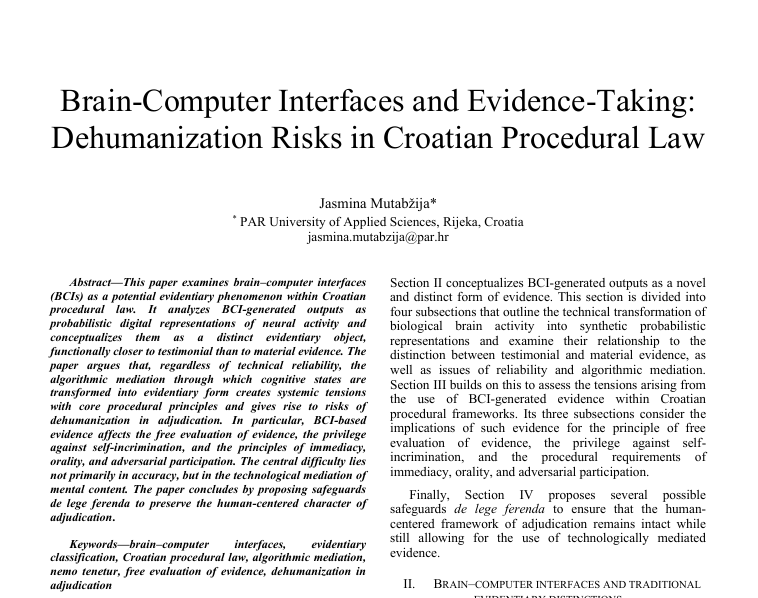
- Jasmina Mutabžija, Brain-Computer Interfaces and Evidence-Taking: Dehumanization Risks in Croatian Procedural Law, 49th MIPRO ICT and Electronics Convention (MIPRO)/ICTLAW, 2026., str. 1930.-1936.
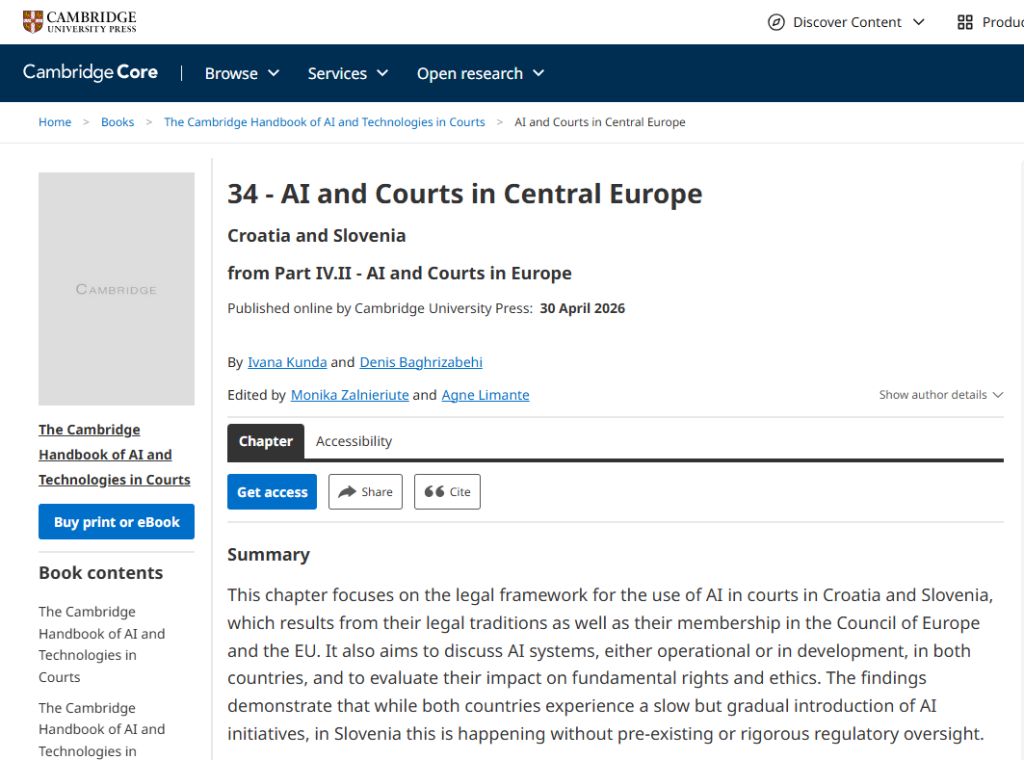
- Ivana Kunda and Denis Baghrizabehi, AI and Courts in Central Europe: Croatia and Slovenia, in: Monika Zalnieriute and Agne Limante (eds.), The Cambridge Handbook of AI and Technologies in Courts, Cambridge University Press, 2026.
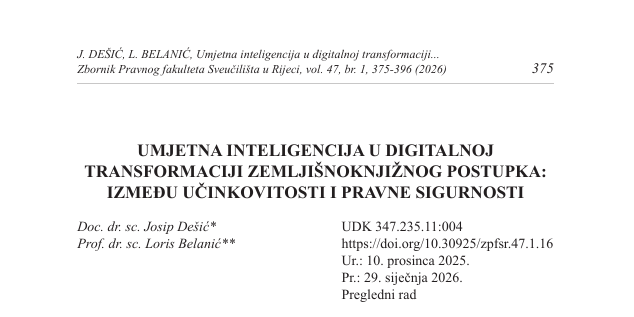
- Loris Belanić and Josip Dešić, Artificial intelligence in Digital Transformation of the Land Registration Procedures: Between Efficiency and Legal Certainty, Collected Papers of the Faculty of Law of the University of Rijeka, vol. 47, no. 1, 2026, pp. 375-396.
Conference organisation:
- 9th International Scientific Conference Petar Šarčević “Automated Vehicles at the Crossroads: Law, Policy and Deployment in Transition”, organiser: Faculty of Law in Rijeka, 13 and 14 November 2025, Rijeka (Croatia)
Conference presentation:
- Jasmina Mutabžija, Brain-Computer Interfaces and Evidence-Taking: Dehumanisation Risks in Croatian Procedural Law, Conference MIPRO 2026: ICTLAW – Information and Communication Technology Law, organiser: Association MIPRO, 28 May 2026, Opatija, Croatia.
- Ivana Kunda, Coding Justice: The Rise of Legal Tech in Croatia’s Courts, CICL 2026: 16th Conference on Innovation and Communications “Local, Regional and Global Interests in Innovation, Communications and Intellectual Property Law”, organiser: Faculty of Law in Szeged, 21-22 May 2026, Szeged (Hungary)
- Jasmina Mutabžija, From Mind to Machine: BCI-Generated Works and the Erosion of Human Authorship in EU Copyright Law, CICL 2026: 16th Conference on Innovation and Communications “Local, Regional and Global Interests in Innovation, Communications and Intellectual Property Law”, organiser: Faculty of Law in Szeged, 21-22 May 2026, Szeged (Hungary)
- Loris Belanić and Josip Dešić, Artificial intelligence and Digital Transformation of the Land Registration Procedures: Between Efficiency and Legal Security, 32nd International Law Conference “Petar Simonetti” (ownership – obligations – procedure), organiser: Faculty of Law in Rijeka, 15-17 April 2026, Poreč (Croatia)
- Jasmina Mutabžija, Beyond Safety: The Case for Normative Legal Intervention in Ethical Decision-Making of Autonomous Vehicles, 9th International Scientific Conference Petar Šarčević “Automated Vehicles at the Crossroads: Law, Policy and Deployment in Transition”, organiser: Faculty of Law in Rijeka, 13-14 November 2025, Faculty of Law in Rijeka, Rijeka (Croatia)
- Ivana Kunda, Who Do We Trust When No One Is Driving? Rethinking Trustworthiness in Automated Vehicles, 9th International Scientific Conference Petar Šarčević “Automated Vehicles at the Crossroads: Law, Policy and Deployment in Transition”, organiser: Faculty of Law in Rijeka, 13-14 November 2025, Rijeka (Croatia)
Popularisation activity:
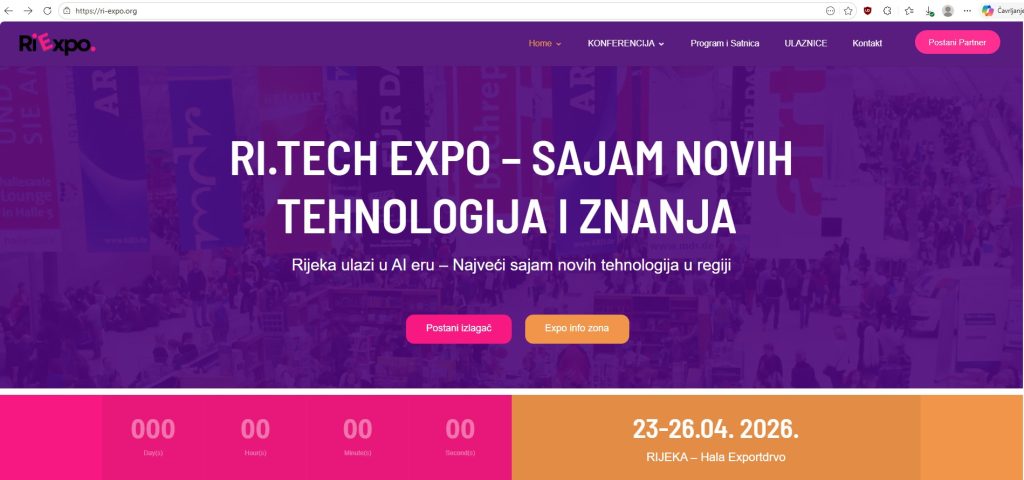
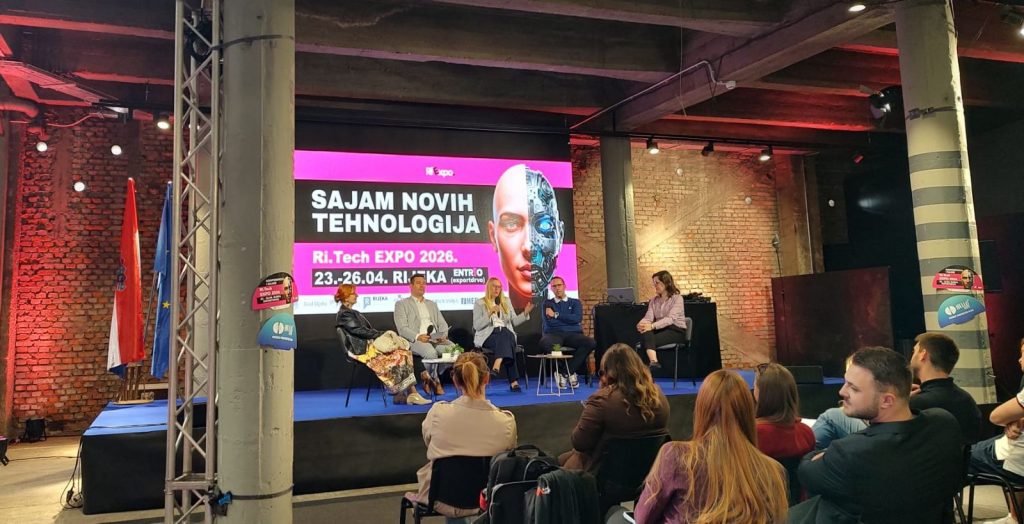
- Ivana Kunda, panel discussion Law, Ethics and Artificial Intelligence, within the event Ri.Tech Expo – Fair of new Technologies and Knowledge, 24 April 2026, Exportdrvo, Rijeka (Croatia)
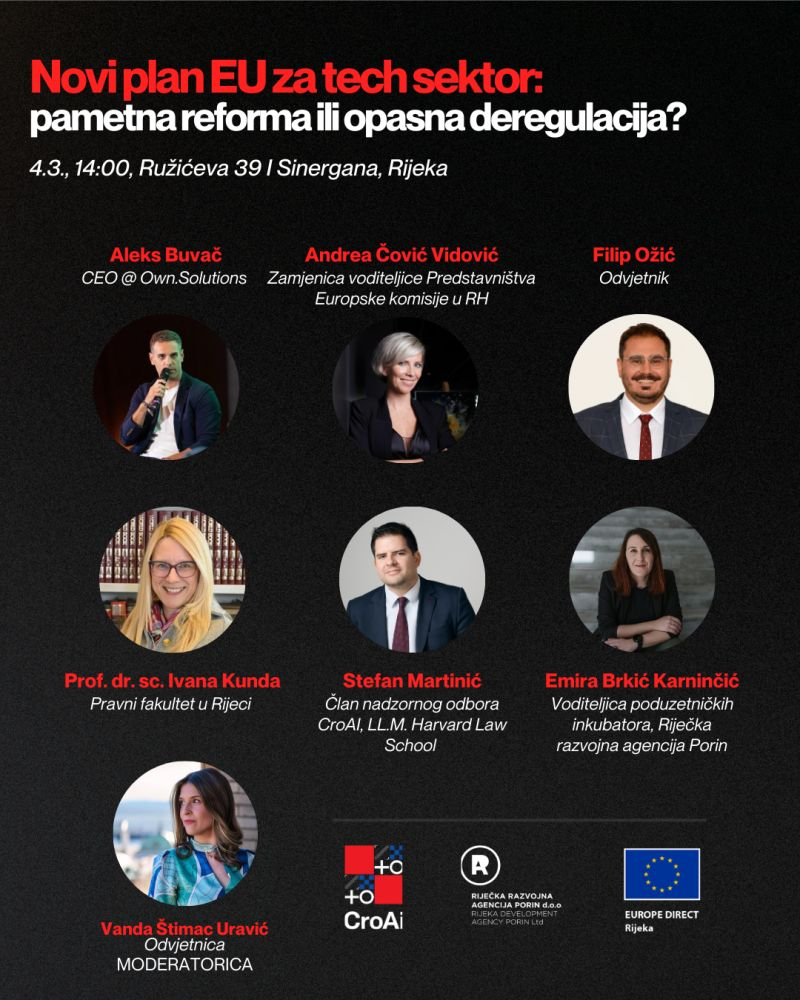
- Ivana Kunda, panel New Plan for the Tech Sector: Smart Reform or Risky Deregulation?, organisers: CroAI (Croatian AI Association) and Riječka razvojna agencija Porin, 4 March 2026, Sinergana, Rijeka (Croatia).
Media and Other:
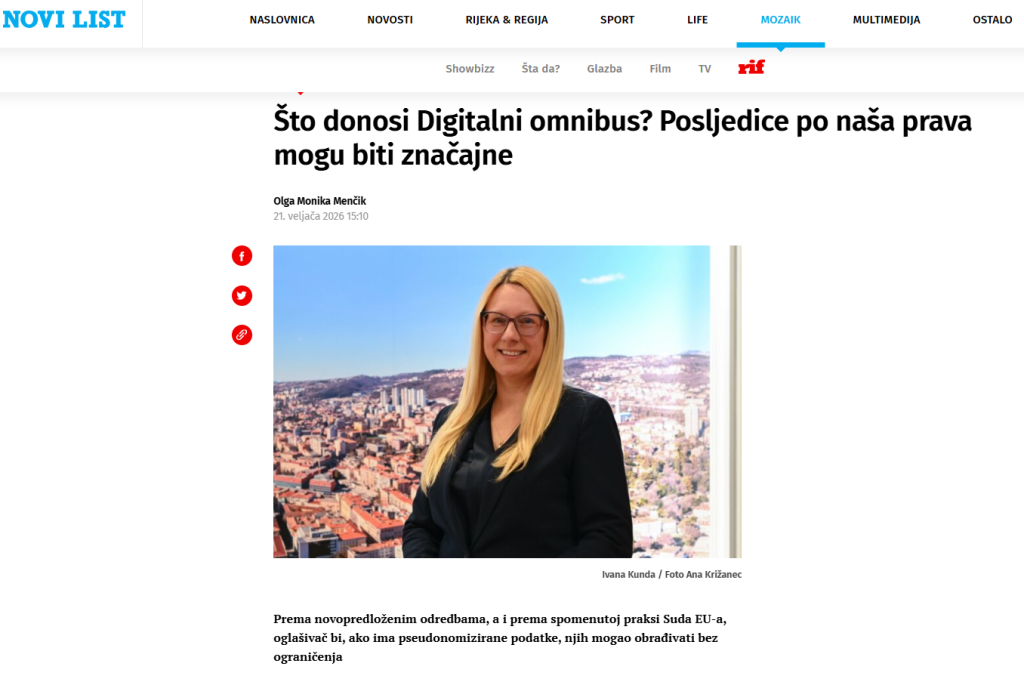
- Intervju Ivane Kunde za Novi list, 21. veljače 2026., Što donosi Digitalni omnibus? Posljedice po naša prava mogu biti značajne (autorica: Olga Monika Menčik).